 EN

Key Structural Features of a Tall Standing Tool Cabinet
A standing tool cabinet can make useful use of vertical space, but its value is not established by height alone. For a workshop, distributor, or OEM brand, the practical question is how the cabinet body, doors, lock, shelves, and installation method work together in the intended workflow. From a sheet-metal planning perspective, a standing tool cabinet should be reviewed through component layout, assembly logic, and the details that need documented confirmation.
That sounds straightforward, but the next question is how tools actually move through the workspace. A tall format may keep reserve stock and less-frequent tools off the floor; it may also introduce reach, door-swing, and stability questions. The goal is not maximum storage in theory, but useful access in the actual work area.
Start with the cabinet body and load path
The outer shell is the starting point for a standing tool cabinet. Ask how the side panels, top, back, base, and internal shelf supports are joined, because those relationships affect how the cabinet carries its intended contents. A tall enclosure can behave differently from a low chest: its vertical panels and back panel contribute to keeping the body aligned when doors are opened and shelves are loaded.
Rather than treating “steel cabinet” as a complete specification, request the drawing or approved product data that identifies material grade, sheet thickness, formed edges, joining method, shelf supports, and any reinforcing members. These details are not interchangeable across every standing tool cabinet. Before relying on a load or rigidity statement in a purchase decision, ask for the relevant drawing, sample detail, or approved specification.
Also examine the base. Depending on the planned installation, a standing tool cabinet may need level feet, a plinth, mounting points, or another defined method for positioning. The supplier should clarify whether anchoring is required, optional, or not included for the proposed configuration. Do not infer that a tall cabinet is tip-resistant simply from a product image.
Review doors as moving structural parts
Doors do more than close a standing tool cabinet. Their hinge locations, return flanges, closing alignment, and contact with the frame determine whether the enclosure closes consistently in daily use. Check the opening direction, opening angle, and clearance required in front of the cabinet. A cabinet that fits against a wall on a layout drawing may still interfere with an aisle, bench, or adjacent cabinet once the doors are open.
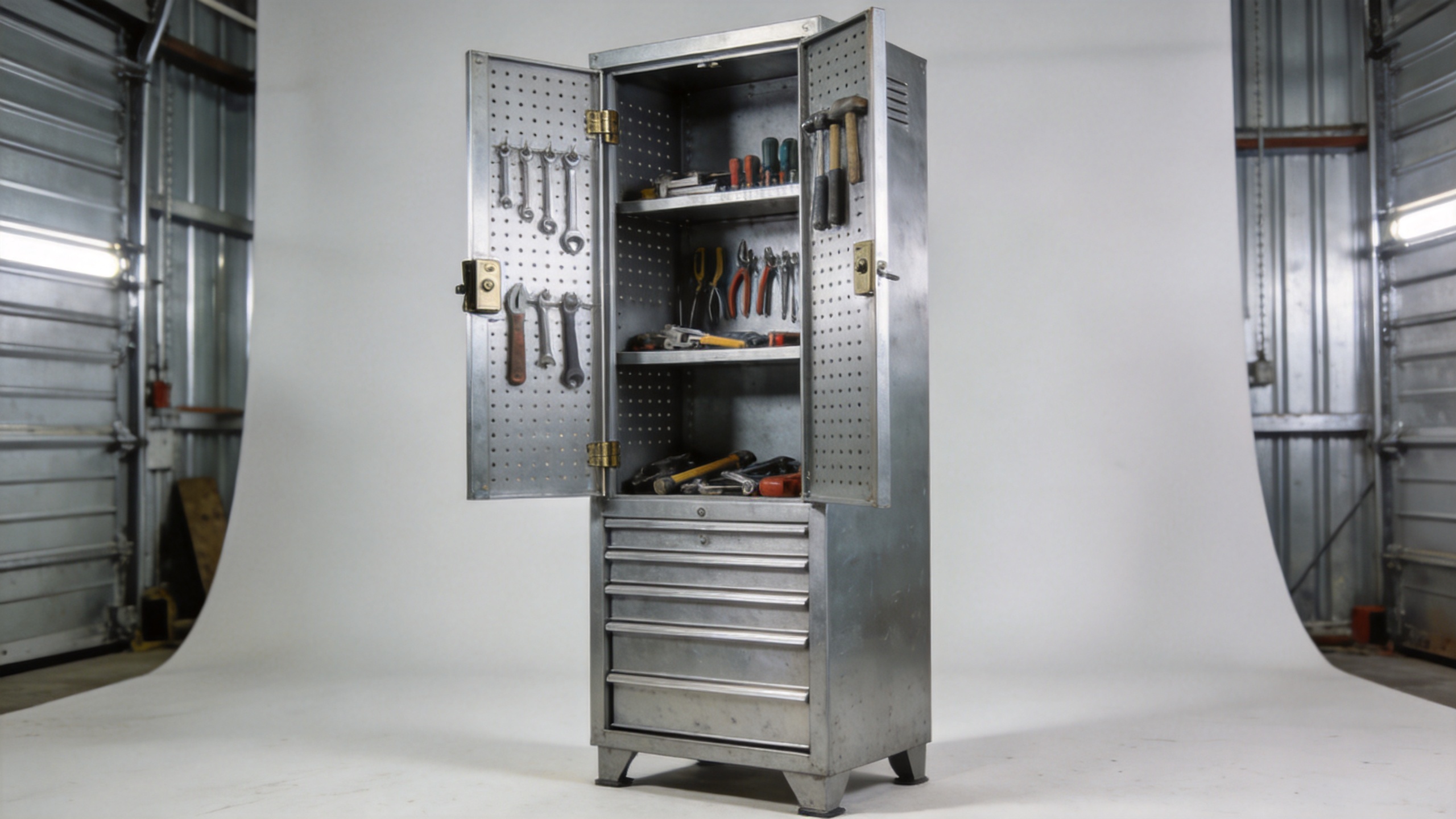
Pegboard doors add a second function: they can create a visible location for light, frequently reached hand tools. Yet pegboard doors are not merely decorative panels. Confirm the panel material, hole pattern, compatible hooks or holders, expected loading method, and whether the added contents affect door operation. The more useful question is whether pegboard doors support the next task without creating a clearance or hinge-load problem.
If a door-mounted organizer is under consideration, ask for a sample or detailed photo that shows the backside, reinforcements, hardware, and any stated restrictions. Product images can show appearance, but they do not establish the permitted load or the relationship between a pegboard accessory and the door structure.
Assess the locking system as a complete path
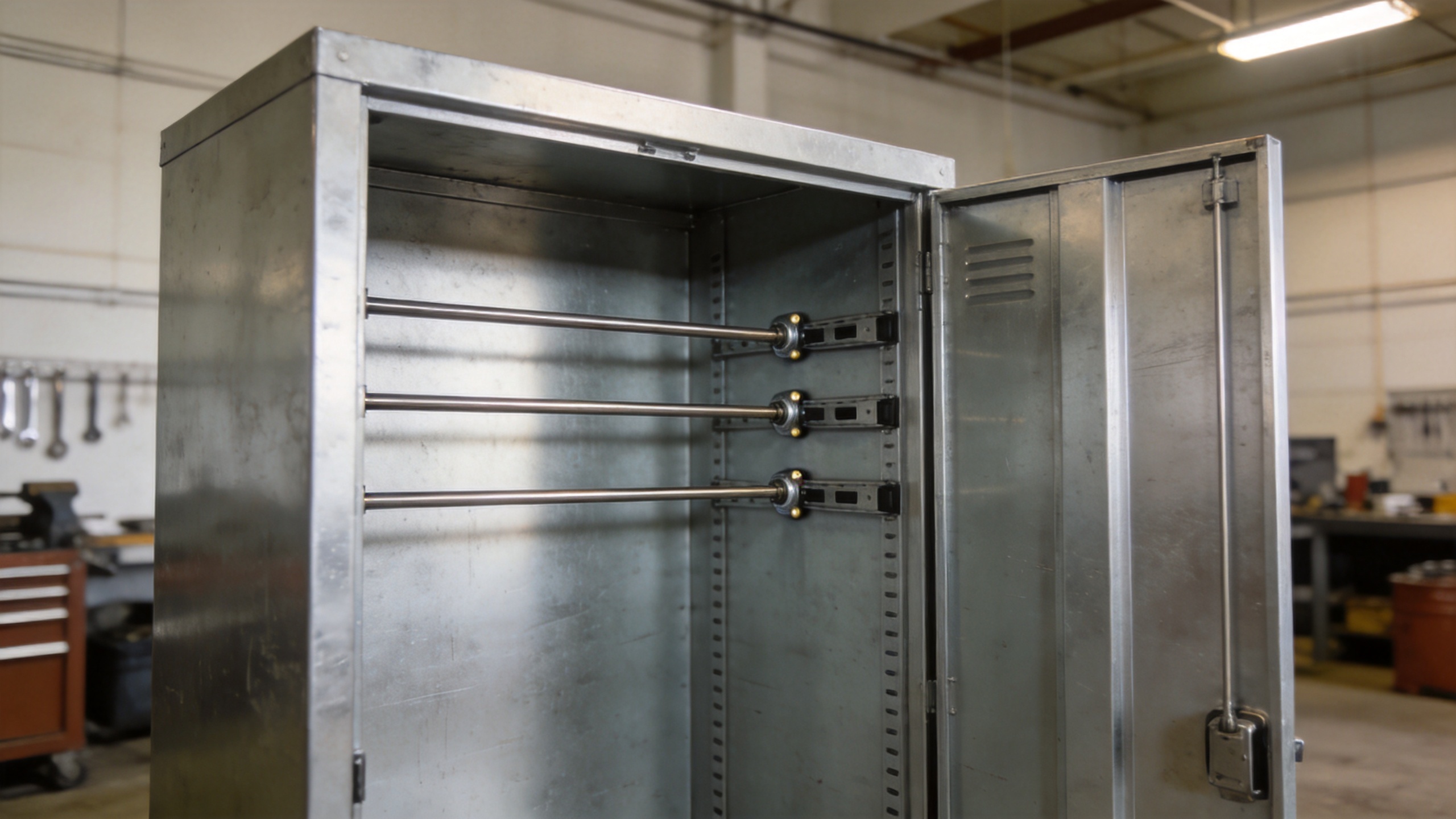
A lock label alone says little about how a standing tool cabinet closes. With a three point locking rod arrangement, the review should include the handle or lock body, rods, guides, receiver points, door edges, and frame contact. In principle, a three point locking rod is intended to engage at multiple locations; the buyer still needs to verify which points are engaged in the offered design and how the parts are retained.
Ask whether the three point locking rod is supplied on one or both doors, how the rods are guided, what happens at the top and bottom receiver points, and whether adjustment is available during assembly or service. These questions matter because a three point locking rod functions as a system, not as an isolated hardware name. Treat the feature as a review point until the supplied specification confirms the actual construction.
For shared work areas, also confirm the keying or access-control approach, replacement-key process, and the boundary between the lock’s role and wider site security procedures. A standing tool cabinet can support controlled storage, but it does not replace the user’s responsibility to define access rules.
Make shelves, compartments, and access zones match the tool mix
Shelf count is another feature that needs context. In a standing tool cabinet, the clear opening height, shelf adjustment positions, support method, and stated shelf load all influence what can be stored safely and retrieved comfortably. Reserve bulky or seldom-used items for zones that do not interrupt daily work, then keep frequently used items within the most practical reach range.
This is not really a question of choosing the biggest standing tool cabinet; more accurately, it is a question of choosing the most usable layout. Capacity was not the only question; the more useful question was how quickly daily-use tools could be retrieved and returned. If tools vary greatly in size, ask whether a combination of shelves, drawer modules, bins, or a separate mobile unit would make the system easier to manage.
Pegboard doors can help keep selected hand tools visible, while enclosed shelves can protect grouped supplies from dust or casual handling. The final grouping should follow the actual take-out-and-return routine, not an empty-space calculation. Repeated searching is a signal to revisit labeling, grouping, or location, not simply to add more storage.
Use a verification checklist before approving a configuration
- Request the overall dimensions, usable internal dimensions, door-swing clearance, and installation guidance for the proposed standing tool cabinet.
- Confirm the cabinet-body material, thickness, formed edges, joints, base arrangement, and any anchoring requirements.
- For shelves, confirm adjustment positions, support construction, and the stated load basis for the actual configuration.
- For pegboard doors, confirm compatible accessories, intended loading, reinforcement, and clearance with stored tools.
- For a three point locking rod, confirm the lock path, engagement points, guides, receivers, and service or adjustment details.
- Review a current drawing, sample, or approved specification before turning any feature into an external product claim.
Turn structural questions into a clearer supplier brief
For an OEM brand, a standing tool cabinet brief is stronger when it separates confirmed requirements from open options. State the intended tool mix, placement, access routine, locking expectation, door organization, finish scope, branding needs, and packaging requirements. Then ask the supplier to identify what is standard, what is configurable, and what requires engineering confirmation.
Haiyang Libenli Metal & Technology Co., Ltd. describes its business around sheet-metal processing, metal furniture, and customized solutions. That manufacturing context is relevant to a structural conversation, but it is not proof of a particular cabinet feature. The responsible next step is to align the selected standing tool cabinet configuration with drawings, samples, and approved details before publication or purchase approval.
A tall cabinet can improve vertical use of space, but the decision should account for reach, placement, and door access. Use the checklist above to convert broad feature language into reviewable evidence, especially where three point locking rod hardware or pegboard doors are part of the requested design.
 Hot News
