 EN

What Makes a 3 Tier Mobile Tool Cart Easy to Maneuver?
A mobile tool cart earns its place when it follows the work instead of making the work follow it. A three-tier layout can keep commonly used items visible and close to hand, but easy movement comes from more than adding wheels. The route, the caster arrangement, the load on each shelf, and the way a person guides the frame all affect how a mobile tool cart feels in a real workshop.
As a workshop user, start with the daily loop: pick up tools, move to the task, position the cart, work, and return it to its parking spot. That sequence sounds simple, yet it reveals why a mobile tool cart that rolls freely in an empty aisle may still feel awkward beside a bench, around a corner, or over a floor transition. The right choice depends on the confirmed layout and tool mix rather than on a generic feature list.
Start with the movement route, not the wheel description
Before comparing a mobile tool cart, trace the path it will actually take. Measure the narrowest aisle, note door thresholds or expansion joints, and identify where the cart must turn or park. A three-tier cart needs enough clearance not only for its body but also for the user’s hands and the arc created while steering. If the route includes tight turns, an otherwise roomy cart can become difficult to place precisely.
Ask one practical question: which tools need to be reached without interrupting the task in front of you? A mobile tool cart is most useful when the answer matches a repeatable work zone. It may move between stations several times a day, or it may make one move at the beginning of a shift and remain parked. Mobile does not mean constant movement; it means the cart can be repositioned when the workflow calls for it.
Why swivel polyurethane casters matter
Casters determine how a mobile tool cart changes direction. Swivel casters rotate 360 degrees, allowing the wheel to align with a new direction rather than forcing the frame to slide sideways. That makes them relevant where a cart must turn into a narrow bay, pivot clear of a bench, or correct its position near a machine.
Swivel polyurethane casters are often considered for carts because polyurethane can be evaluated for its interaction with a particular floor surface. The point is not to assume that one wheel material suits every site. Floor debris, seams, moisture, cleaning routines, and load all deserve review. On a clean, smooth route, a mobile tool cart may need very little push force; on a rough route, wheel diameter and tread condition can matter just as much as the swivel action.
Caster layout should be checked as a system. Two fixed casters can help a mobile tool cart track in a straight line, while swivel casters provide steering; four swivel casters can make close positioning easier but may feel less directional on a long run. The usable arrangement depends on the route and operator preference. Confirm the actual caster count, swivel locations, brake design, wheel diameter, and stated load rating from the approved specification before final selection.
Keep the center of gravity predictable
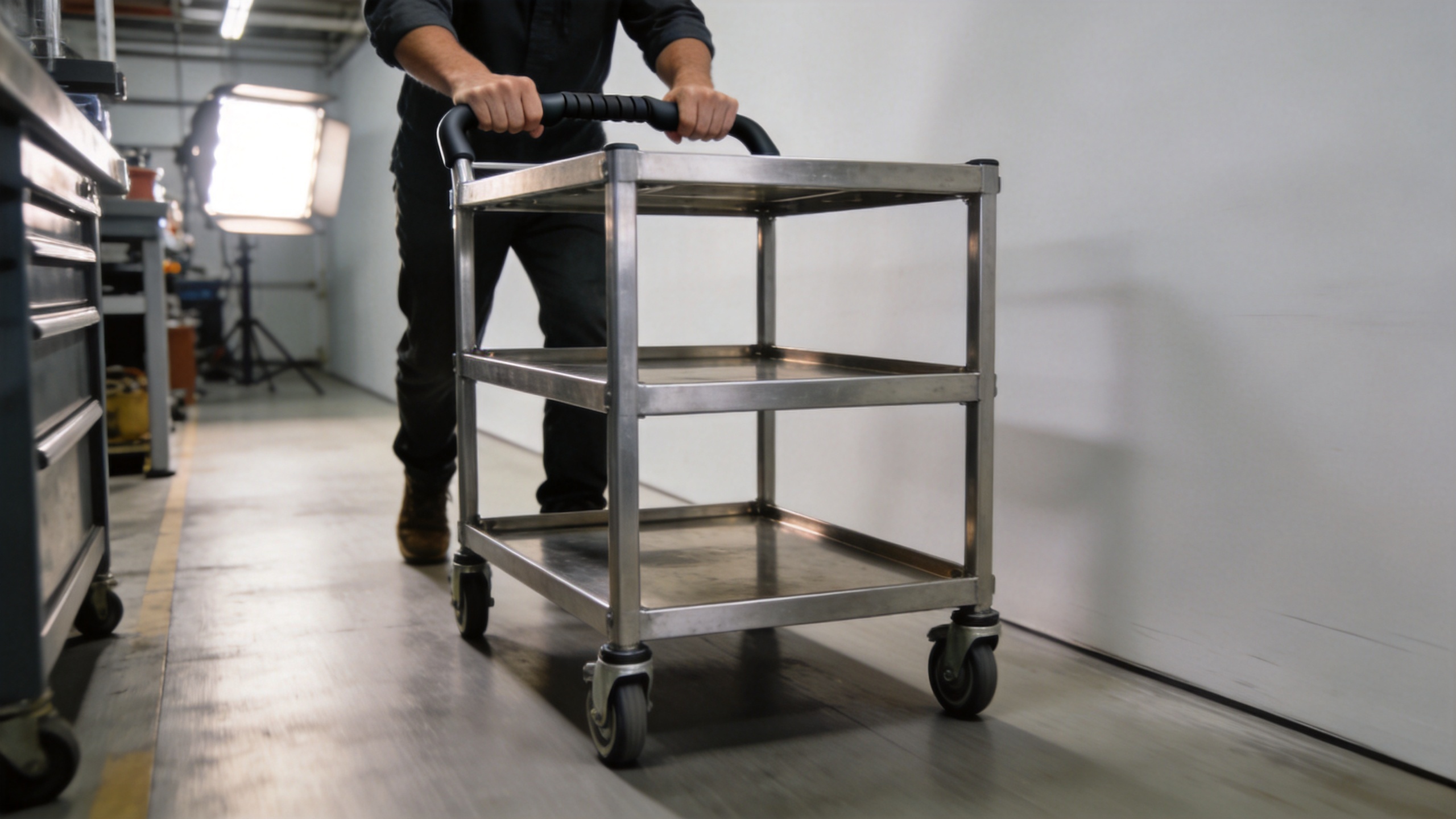
A three-tier mobile tool cart can become harder to guide when weight is placed high or unevenly. Load the lower tier with denser items where practical, keep long tools from projecting into walking space, and avoid turning the top tray into a pile of loose parts. This is not simply a capacity issue. A balanced load helps the user feel the cart’s response during a turn and reduces the need for abrupt corrections.
Think about retrieval as well as transport. The top tier of a mobile tool cart is usually the quickest place to access the items used at the current task. The middle tier can support grouped hand tools or consumables, while the lower tier can carry items that are heavier or used less often. The exact arrangement should follow the tool inventory and the maker’s approved loading guidance. More items on the cart do not automatically make it more useful.
A push handle should support controlled steering
A push handle changes how the operator connects to the cart. It gives a clear steering point and can help keep hands clear of shelves, stored tools, and nearby work surfaces. On a mobile tool cart, the handle should be evaluated for height, reach, grip shape, attachment method, and its relationship to the caster layout. A handle that is comfortable on a straight route may be less helpful if it forces the user to twist around a tight corner.
Try a simple positioning test before committing to a layout. With a representative, approved load, push the mobile tool cart forward, pull it back, guide it through the tightest turn, and park it at the work zone. Notice whether the push handle leaves enough room for the user’s knuckles and whether the cart responds without a sudden swing. This kind of check is more useful than assuming that a handle alone makes a cart easy to maneuver.
Brakes make parking part of maneuverability
Easy maneuverability includes stopping in the right place. Once a mobile tool cart reaches a station, the operator needs a repeatable way to keep it from drifting while tools are removed or returned. Check the brake type, operating motion, accessibility, and the conditions under which it is intended to hold. Brakes should be assessed alongside the floor, the expected load, and the work activity, not as an isolated checkbox.
Parking location matters too. Leave a clear return path, keep the cart outside emergency access routes, and avoid a position that blocks drawers, doors, or another worker’s turning space. A mobile tool cart works as a moving access point, not as permanent storage placed wherever there happens to be open floor area.
A practical checklist for a three-tier cart
- Map the daily route, narrowest clearance, turns, thresholds, and parking zone for the mobile tool cart.
- Confirm caster layout, wheel material, swivel function, brakes, and the approved load rating from current product documentation.
- Assess swivel polyurethane casters against the actual floor and cleaning conditions rather than treating them as a universal solution.
- Place the heaviest expected items lower and group frequently used tools where they can be reached without disrupting the task.
- Test the push handle with a representative load, including forward movement, reverse movement, a tight turn, and final parking.
- Review the plan after the tool mix or work sequence changes; a mobile tool cart should continue to fit the daily loop.
Choose maneuverability as a workflow fit
The most practical mobile tool cart is not defined by one feature. It combines a route that permits movement, casters suited to the floor and turning needs, a stable loading plan, a usable push handle, and a clear parking routine. If a brand or procurement team is developing a three-tier configuration, document these conditions in the brief along with dimensions, finish requirements, expected tools, packaging scope, and any drawings or samples needed for confirmation.
For metal-storage projects, Haiyang Libenli Metal & Technology can discuss requirements around sheet-metal fabrication and customized solutions when the intended configuration is clearly defined. The next useful step is to match the mobile tool cart layout to the real route and then verify product-specific details against current approved documentation.
 Hot News
