 EN

Why Assembly Plants Deploy a Heavy Duty Tool Cart?
At an assembly station, a missing driver or a shared gauge can interrupt the sequence of work. The question is whether the right tools are accessible where the work happens. A heavy duty tool cart gives a plant a movable place for that set, provided its layout, load rating and route match the job.
From a workshop organization perspective, the useful question is not how many drawers a cart has. It is how workers retrieve, use and return tools throughout a shift. Mobility is valuable when a tool set travels between work points; a fixed cabinet may be more appropriate when everything stays at one station.
Put the working set near the operation
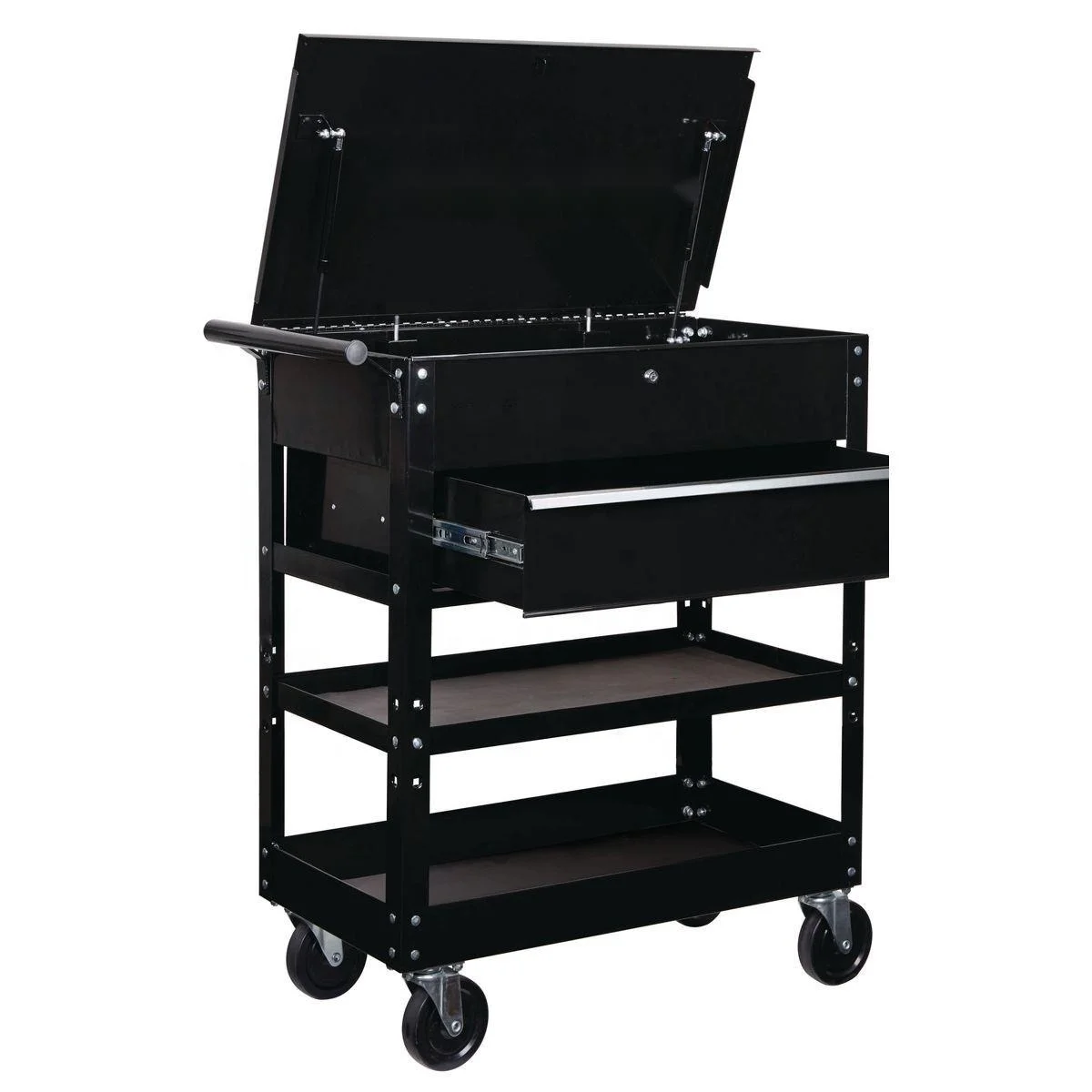
Assembly teams may move between fixtures, perform changeovers or share inspection tools. A heavy duty tool cart can carry a defined working set between those locations instead of relying on a distant storage point. A drawer layout organized by task can make the next tool easier to locate, while a designated return position makes an incomplete set more visible.
Consider an illustrative situation: a technician needs drivers, sockets and a measuring tool at two neighboring stations. The team could group those items in labeled positions and move the cart only when the second station needs them. This is a planning example, not a reported customer result. Whether it helps depends on the distance, the number of users and the space available around each workstation.
For tools needed continuously at one fixed position, movement may add no value. Compare the cart with a stationary cabinet or point-of-use storage before committing floor space to wheels.
Match the structure to the actual load
The term heavy duty tool cart describes a category, not a universal capacity. Start with the weight of the empty cart, the tools, accessories and any other items it will carry. Ask the supplier for the permitted total load and, where applicable, separate limits for drawers, shelves and the work surface. These are different limits; a total rating alone does not establish what one drawer can hold.
Load distribution matters as well. Keep heavier items low when the design and supplier instructions allow it, and consider what happens when a drawer is open. Confirm whether the selected unit has a drawer interlock, an anti-tip arrangement or other features relevant to the intended use. Do not assume that a name, a steel body or a photograph proves stability.
Some specifications include reinforced corner posts as one possible structural feature. Ask how those posts connect to the frame and which evidence supports the stated load rating. Reinforced corner posts do not, by themselves, establish an allowable capacity or certify the entire assembly. Review joints, drawer supports and wheel mounting points as part of the same configuration.
Choose wheels for the route, not just the catalog
A heavy duty tool cart must move over the surface found in the plant, including any floor joints, thresholds and turns on its planned route. Map the narrowest passages and check doorways, crossings and the space needed to turn before choosing the cart footprint. Trial the proposed route with the intended load when it is safe and the supplier permits it.
For caster selection, account for the weight of the cart and its maximum expected contents, then confirm the complete caster arrangement and rated capacity with the supplier. Uneven floors and changes in load distribution can affect individual wheels; a simple division of total weight by the number of wheels may not capture the actual conditions. Wheel material, floor compatibility, rolling resistance and exposure to oils or debris also deserve review.
Locking casters are useful to assess where a cart will be parked for tool access. Verify whether the mechanism locks wheel rotation, swivel movement or both, and identify which wheels have it. Locking casters are not a substitute for the supplier's instructions on slopes, loading or parking. Workers should close drawers before movement and follow the site's handling procedures.
In the United States, OSHA's general materials-handling rule, 29 CFR 1910.176(a), addresses safe clearance where mechanical handling equipment is used and requires aisles to be kept clear of hazards. Its applicability depends on the operation; the plant's safety team should check the relevant requirements for its location and equipment. A parked cart should not obstruct an aisle or access to emergency equipment.
Make shared storage work across shifts
A heavy duty tool cart can serve more than one operator if the group agrees what belongs in it. List the tools by operation, assign a home position and decide who checks the contents during handover. Labels or shaped inserts may help reveal an absent item, but they should match the actual tool set rather than force an awkward arrangement.
Separate frequently used tools from items needed only for occasional maintenance. Keep the working surface clear enough for the task, and check that an open drawer does not block a neighboring operator. If a shared cart regularly waits at another station, a second fixed set may be a better fit than adding more storage to the same unit.
Security is another distinct decision. If tools need controlled access, ask about the lock, key management and the effect of locking on shift handover. A lock can control access; it does not replace a tool accountability process.
Turn the plant's needs into a supplier brief
For a brand sourcing a heavy duty tool cart for assembly users, a clear brief makes competing proposals easier to compare. Include the tool list and expected loaded weight, intended drawer arrangement, available footprint, route conditions and any required finish or identification. Specify which points are essential and which can be reviewed during sampling.
- Request the allowable total load and individual drawer or shelf ratings for the exact configuration.
- Confirm frame construction, wheel mounting and any proposed reinforced corner posts against drawings or supplier documentation.
- Define the wheel layout and ask exactly what the locking casters secure.
- Check access height, drawer extension, operating clearance and handling instructions with the intended users.
- Agree on the finish, labeling, packaging and any brand-specific changes before comparing quotations.
Haiyang Libenli Metal & Technology describes sheet-metal and pipe processing and customized solutions in its company profile. For a sourcing discussion, provide the intended application and ask which cart configuration, documentation and sample review are available; specific product features and capacities need confirmation for the selected design.
Start with the movement that matters
A heavy duty tool cart earns its floor space when it supports a real movement and access pattern. Map the route, define the tool set, check the loads and involve the people who will use it. If those checks point to a stationary solution instead, that is a useful outcome too. Choose storage that fits the work, rather than adding wheels for their own sake.

 Hot News
