 EN

2026 B2B Sourcing Trends for the Metal Custom Tool Box
For a brand sourcing a custom tool box, the practical question in 2026 is not simply which format looks right in a catalog. It is whether a supplier can turn a brief into a reviewable metal-storage configuration, then keep the commercial and technical details aligned as the project moves forward. Search results for this category still lean heavily toward retail boxes, garage organization, and product assortments. B2B buyers need a different lens: scope control, evidence, finish planning, and a clear path from RFQ to sample review.
That sounds straightforward, but the next question is how the tools, users, brand requirements, and production decisions actually move through the project. A custom tool box may be a drawer unit, a portable chest, a cabinet-based module, or part of a wider storage range. The useful sourcing conversation starts with that workflow rather than with a generic product name.
Trend 1: Buyers are comparing supplier scope before unit price
In 2026, stronger RFQs define the configuration before asking suppliers to compare cost. The difference is important. A quote for a custom tool box is difficult to compare if one supplier assumes a standard drawer arrangement while another allows for altered dimensions, branding, finish, packaging, or accessory requirements. A lower initial figure may not be the more suitable option if it leaves those decisions unresolved.
For an OEM brief, translate brand requirements into confirmable product details. Start with the intended tool groups, access frequency, placement, mobility needs, and the relationship between the box and any surrounding cabinets or carts. Then list the requested sheet-metal layout, drawer or door arrangement, handle style, hardware expectations, color, logo treatment, packaging, and approval milestones. This creates a common basis for supplier conversations.
- Separate fixed requirements from options that still need a technical review.
- Ask each supplier to identify assumptions and exclusions in writing.
- Use drawings, finish samples, and packaging proposals as review items rather than relying on broad descriptions.
- Record how a design change will be evaluated after the first quotation or sample stage.
Capacity is not the only question; the more useful question is how daily-use items will be retrieved and returned. That shift helps a buyer decide whether a deeper box, a drawer-based layout, or a modular combination deserves further discussion.
Trend 2: OEM design service is becoming a review process, not a vague promise
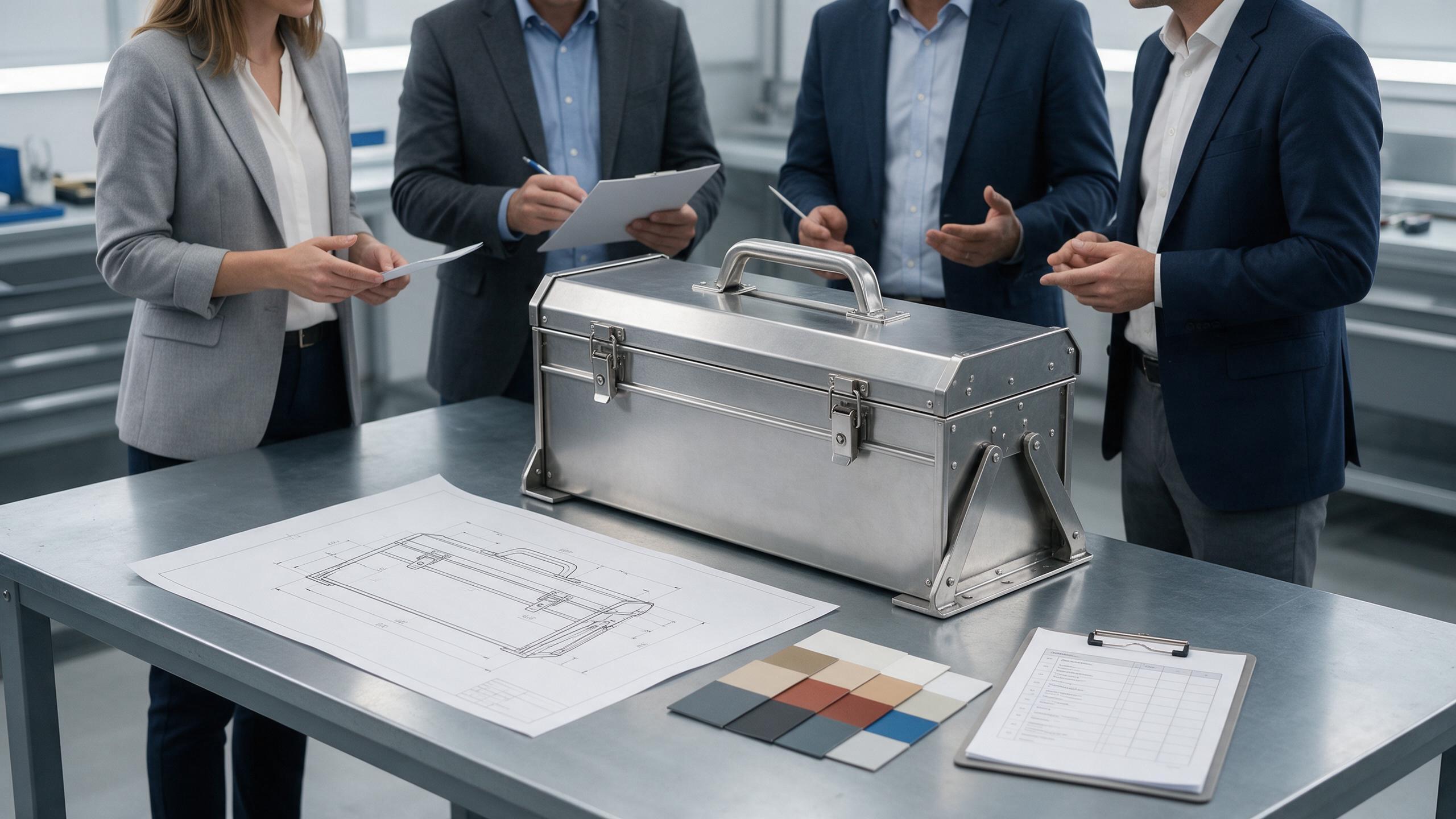
Many buyers now expect an OEM design service to provide a practical way to move from a concept to a controlled specification. The term should mean more than placing a logo on an existing item. For a metal custom tool box, an early review can clarify which requests are standard, which require a configuration change, and which details need drawings or samples before production planning.
A useful review sequence begins with the product brief and usage setting. It then documents the cabinet or box dimensions to be confirmed, part layout, assembly logic, finish requirements, branding locations, and packaging needs. From a sheet-metal planning perspective, these are the details that make the request reviewable; they are not reasons to claim an outcome before the specification is approved.
Buyers can make the conversation more productive by asking for a revision log. Each version should show what changed, why it changed, and what still requires confirmation. This is especially helpful when procurement, product, and marketing teams all influence the same range. In many planning conversations, the access route becomes clearer once the most frequently used tools are grouped first, and the same principle applies to requirements: settle the recurring-use essentials before discussing secondary options.
Trend 3: Finish evidence matters more in a powder coating line discussion
Color and surface appearance are no longer a final-line detail for many B2B programs. Buyers evaluating a powder coating line are asking more specific questions about how finish requirements are communicated, sampled, inspected, and tracked. Industry commentary around fabricated metal finishes points to continuing attention on substrate compatibility, application efficiency, corrosion-resistance expectations, and process consistency. Those are trend signals, not proof of any individual supplier’s performance.
For a custom tool box, the appropriate approach is to define the finish requirement and request evidence relevant to the project. Confirm the substrate and preparation assumptions, the requested color or reference, the desired surface appearance, areas that need protection during shipping, and the acceptance method for samples. If a supplier describes its powder coating line, ask how the requested finish moves through the documented review process rather than assuming that a line name alone answers every quality question.
| Review point | Why it matters for a custom tool box | What to request |
|---|---|---|
| Finish reference | Helps align color and appearance expectations across teams. | Color reference, sample panel, and approved variation notes. |
| Part preparation | Connects the finish discussion to the specified metal parts. | Supplier explanation of the proposed preparation and review steps. |
| Inspection point | Sets a shared acceptance discussion before shipment planning. | Sample-review criteria and the responsible approval contact. |
| Packaging contact area | Surface protection can be affected after finishing. | Packaging proposal for corners, handles, and finished faces. |
Trend 4: Supplier quality reviews are becoming more measurable
2026 supply-chain guidance increasingly frames supplier quality through observable indicators such as defect patterns, first-pass acceptance, and the aging of corrective actions. A buyer does not need to impose a universal scorecard on every project, but a custom tool box program benefits from agreeing on what evidence will be reviewed at each stage.
Rather than waiting for a nonconformance, include early questions about sample acceptance, change notification, and response ownership. The decision changed once the product was treated as one part of a brand’s wider storage system: a late revision to dimensions, labeling, or packaging can affect more than one SKU. A simple review map helps reduce fragmented decisions.
- Confirm the target configuration and the details still open for review.
- Compare quotations against the same scope and note material exclusions.
- Review drawings or samples against the written brief.
- Document changes, approval owners, and the next evidence required.
- Use post-sample feedback to clarify the production-facing specification.
This may be the right direction for a repeat program, although the final review depth still depends on the product complexity, order model, and confirmed specification.
Trend 5: Resilience is being built through clearer collaboration
Supplier resilience is often discussed as a logistics issue, but for metal storage sourcing it also depends on communication quality. Current supplier-quality discussions place more emphasis on process audits, training, and co-engineering alongside the handling of nonconformances. For buyers, the practical takeaway is to assess how clearly a potential partner discusses unknowns, changes, and supporting documentation.
A custom tool box project should therefore include a communication plan: who owns the RFQ clarification, how design questions are captured, when finish samples are reviewed, and how the packaging decision is signed off. Treat the early review as a way to separate standard requests from customization points. This does not promise a particular lead time or result; it simply gives both sides a more usable record for decision-making.
A 2026 sourcing checklist for your next custom tool box
Before selecting a supplier, use the following checklist to turn a broad request into a comparable sourcing package:
- What tools, work sequence, and user environment should the storage support?
- Which dimensions, layout details, and components are mandatory, and which remain flexible?
- What should the OEM design service review before pricing is finalized?
- What evidence should accompany the proposed powder coating line and finish-sample discussion?
- How will drawings, samples, revisions, branding, and packaging be approved?
- Which quality observations or corrective-action steps matter for this program?
The better fit depends on the confirmed workflow and scope, not on a blanket ranking. By treating the custom tool box as a reviewable B2B configuration, buyers can ask sharper questions, compare suppliers on a consistent basis, and carry clearer requirements into the next stage of the project.

 Hot News
