 EN

How a Lockable Tool Box Protects High Value Gauges?
High-value gauges rarely fail because someone intended to misuse them. More often, they are misplaced during a shift change, knocked against heavier tools, left exposed to dust, or handled by people who do not need them for the task at hand. A lockable tool box gives a workshop a defined home for these instruments. It does not replace calibration practice or site access controls, but it can make daily custody, retrieval, and physical care much easier to manage.
From a quality-review perspective, the useful question is not simply “Does it lock?” It is: can the storage setup limit casual access, protect delicate faces and contact points, and make it obvious when a gauge has not been returned? The answer depends on the lock arrangement, the internal layout, and the routine around the box.
Why gauges need more than an open drawer
Dial indicators, pressure gauges, bore gauges, micrometers, gauge blocks, and specialty measuring tools can carry substantial replacement and calibration costs. Their value also lies in the decisions made with them. A gauge with a bent stem, scratched contact surface, contaminated connection, or uncertain custody may create rework long before anyone notices the storage issue.
A lockable tool box helps turn a loose collection into a controlled kit. When the lid or drawers are closed and the key is assigned, the box creates a small boundary around equipment that should not circulate freely. That boundary can reduce accidental borrowing and gives the owner a simple point to check at the end of a job.
Physical care remains equally important. NIST guidance on calibration-item handling emphasizes arrangements that protect an item’s condition and integrity during storage. For gauges, that translates into clean compartments, stable positioning, and separation from pointed or heavy tools. The lock is part of the workflow; the interior is what keeps instruments from colliding once the box is moved.
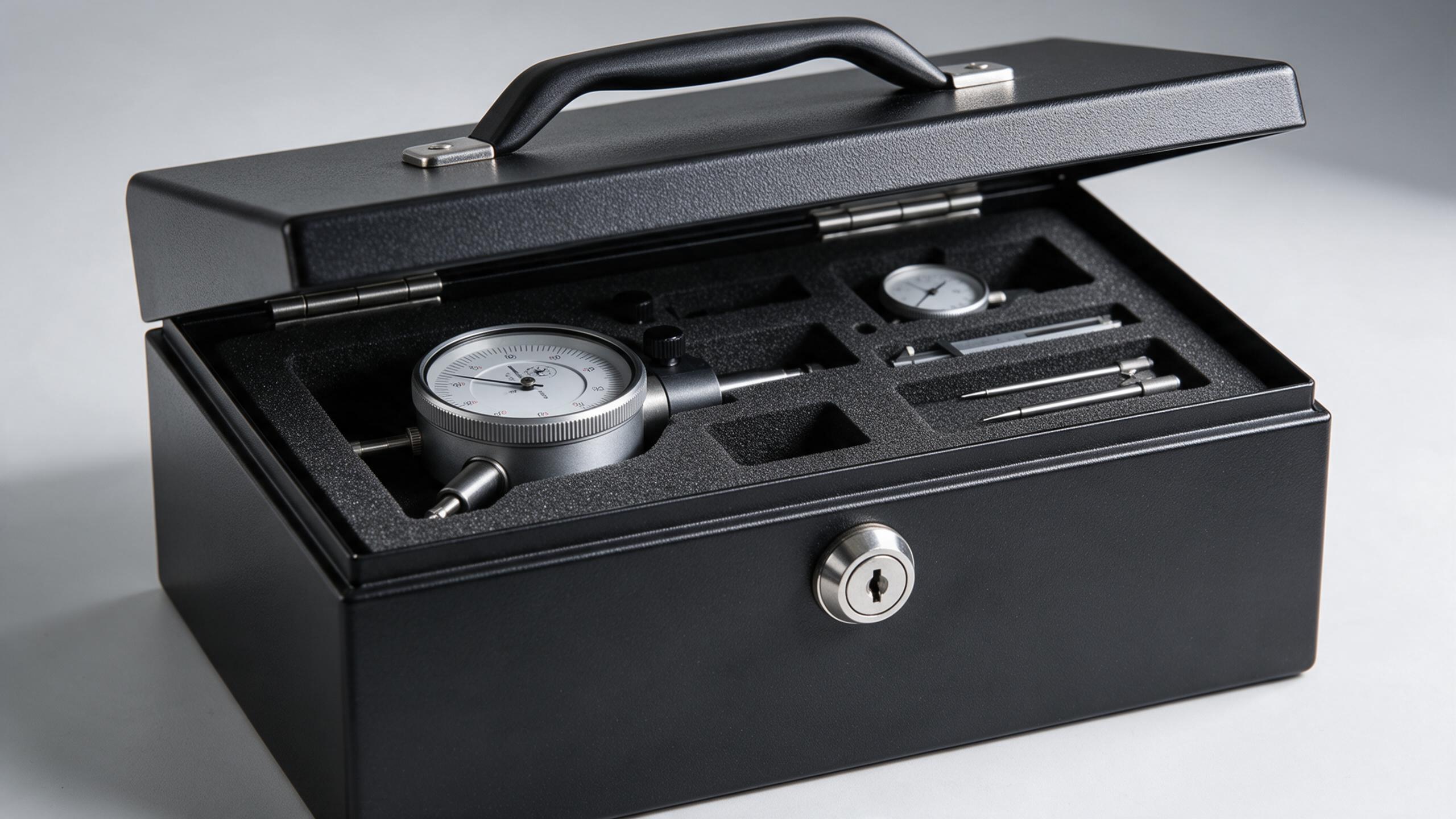
What a lock actually contributes
A lockable tool box is most useful when it supports three practical controls:
- Access control: only designated users can open the gauge kit during a shift or between jobs.
- Visual accountability: a closed, locked box makes an unreturned gauge easier to spot than an open bench drawer.
- Transport discipline: closing the box before it is carried encourages users to return each gauge to its assigned position.
These are deterrence and organization benefits, not a claim that a portable box can defeat every forced-entry attempt. If loss exposure is high, the box should be one layer in a wider system that may include controlled room access, asset records, and a fixed anchor point.
Recessed cam lock: useful for routine access
A recessed cam lock is often chosen for a clean exterior profile. Because the lock face sits below or near the surface, it is less likely to snag clothing or catch on another cabinet while the box is being moved. In a gauge-storage application, its everyday benefit is simple, repeatable access: insert the key, turn it, and secure the lid or door before the box leaves the work area.
Before specifying a recessed cam lock, check how it interacts with the enclosure. The cam must engage a solid receiving point, and the lock should be positioned so normal box flex does not make it difficult to close. Ask the fabricator or procurement team to confirm keying options, replacement-key process, and whether the design supports keyed-alike groups for authorized users. A convenient lock that cannot be serviced or administered consistently can create its own downtime.
Why a steel security bar changes the system
A steel security bar can extend the lock’s function beyond one latch point. Depending on the enclosure design, it may span drawers or reinforce the closing edge so several access points are held in place together. That can be helpful for a box carrying multiple gauge cases, where a single locked lid alone would not keep individual drawers from opening during handling.
Fit matters. The security bar needs a defined engagement path and should not press against calibrated instruments, foam inserts, or case lids. It needs enough clearance to operate without becoming a nuisance, yet it should not rattle when the box is moved. The steel security bar also benefits from a routine inspection: look for loosened fasteners, binding, and wear at the contact points.
Build protection inside the box
Security hardware matters, but an organized interior does much of the day-to-day protective work. Start by grouping gauges according to their sensitivity and use frequency. Frequently used indicators might sit in shallow, labeled positions close to the opening. Fragile or lower-frequency items can remain in their own protective cases or deeper fitted compartments.
| Storage feature | What to verify for gauges |
|---|---|
| Compartment layout | Each item has a repeatable position, with enough separation to avoid metal-to-metal contact. |
| Foam or dividers | Support bodies and accessories without putting pressure on dials, stems, tips, or connectors. |
| Drawer retention | Drawers remain closed while the box is moved and do not open into the instrument storage area. |
| Cleanliness routine | Dust, chips, moisture, and residue are removed before instruments are returned. |
| Key control | Authorized users and spare-key location are known; key handoff is recorded where appropriate. |
A common mistake is treating every empty area as useful capacity. For high-value gauges, unused space can become travel space during transport. It is usually better to leave a deliberate buffer than to pack a delicate instrument beside a heavy wrench simply because it fits.
Use a return-and-lock routine
The storage practice has to be easy enough to follow at the end of a busy job. A short routine can be:
- Wipe the gauge and check for visible damage or contamination.
- Return it to its labeled slot or protective case.
- Check that drawers, lids, and the recessed cam lock engage without forcing them.
- Close the steel security bar, where fitted, and confirm that it is seated.
- Lock the box and return the key according to the team’s access process.
This sequence gives the user a useful pause between measurement work and storage. If a gauge is missing, dirty, or does not sit correctly, the issue is visible before the box is secured. That is a more useful outcome than discovering a problem at the next calibration check.
Questions to ask before choosing a lockable tool box
- Which gauges need individual cases or fitted support?
- Will the box stay on a bench, move between workstations, or travel in a vehicle?
- Does the locking layout secure all relevant drawers and compartments?
- Can users close the lid and lock it without shifting the contents?
- Who holds keys, and what happens when a key is lost or an employee changes roles?
- Does the selected enclosure leave room for inspection labels, calibration records, or an asset list?
For brands sourcing metal storage, these questions are also a useful design brief. A manufacturer can evaluate compartment geometry, latch placement, bar routing, sheet-metal reinforcement, finish requirements, and private-label details once the gauge set and intended workflow are clear.
Protection is a system, not one feature
A lockable tool box helps protect high-value gauges by creating controlled access, a repeatable return location, and a safer enclosure for moving instruments. A recessed cam lock can support convenient daily closure, while a steel security bar may add coordinated retention across the box. Neither feature should be viewed in isolation. The most dependable setup combines appropriate internal support, cleaning habits, key accountability, and a review of whether the box still fits the tools it carries.
When a team can tell where every gauge belongs, who can access it, and whether it was returned in sound condition, storage stops being an afterthought and becomes part of measurement quality.


 Hot News
