 EN

Why Master Technicians Specify a Professional Tool Box?
A busy technician does not judge a professional tool box by its paint color or the number of drawers alone. The useful question is simpler: can the storage layout support the repeated pick-up, use, and return cycle of the workday? From a workshop organization perspective, a tool box becomes part of the process when it puts the right tool within reach, keeps it visible after use, and gives the team a clear place to return it.
That is why experienced technicians often write a more detailed storage brief. They look beyond headline capacity and ask how the cabinet will handle their actual tool mix, work sequence, shared access, and future changes. A well-specified professional tool box is not necessarily the largest unit. It is the configuration that makes routine retrieval easier to manage and review.
Professional storage starts with access flow
Capacity is not the only question; the more useful question is how quickly daily-use tools can be retrieved and returned. Picture a technician moving through inspection, adjustment, assembly, and final checks. If a commonly used driver, socket, measuring tool, or specialty hand tool sits behind several unrelated items, each interruption adds friction. Over a shift, that friction can affect tidiness, handoff routines, and the ability to notice what is missing.
Master technicians therefore map tools by frequency and sequence before selecting a professional tool box. The top or most convenient drawers may suit the tools used in nearly every operation. Mid-level drawers can hold grouped tools for a specific station or task. Deeper storage may be appropriate for less-frequent items, provided the drawer depth, internal clearance, and intended load are confirmed for that use. This is not a universal layout rule; the correct arrangement depends on the tool set and work area.
EVA foam tool control makes the layout visible
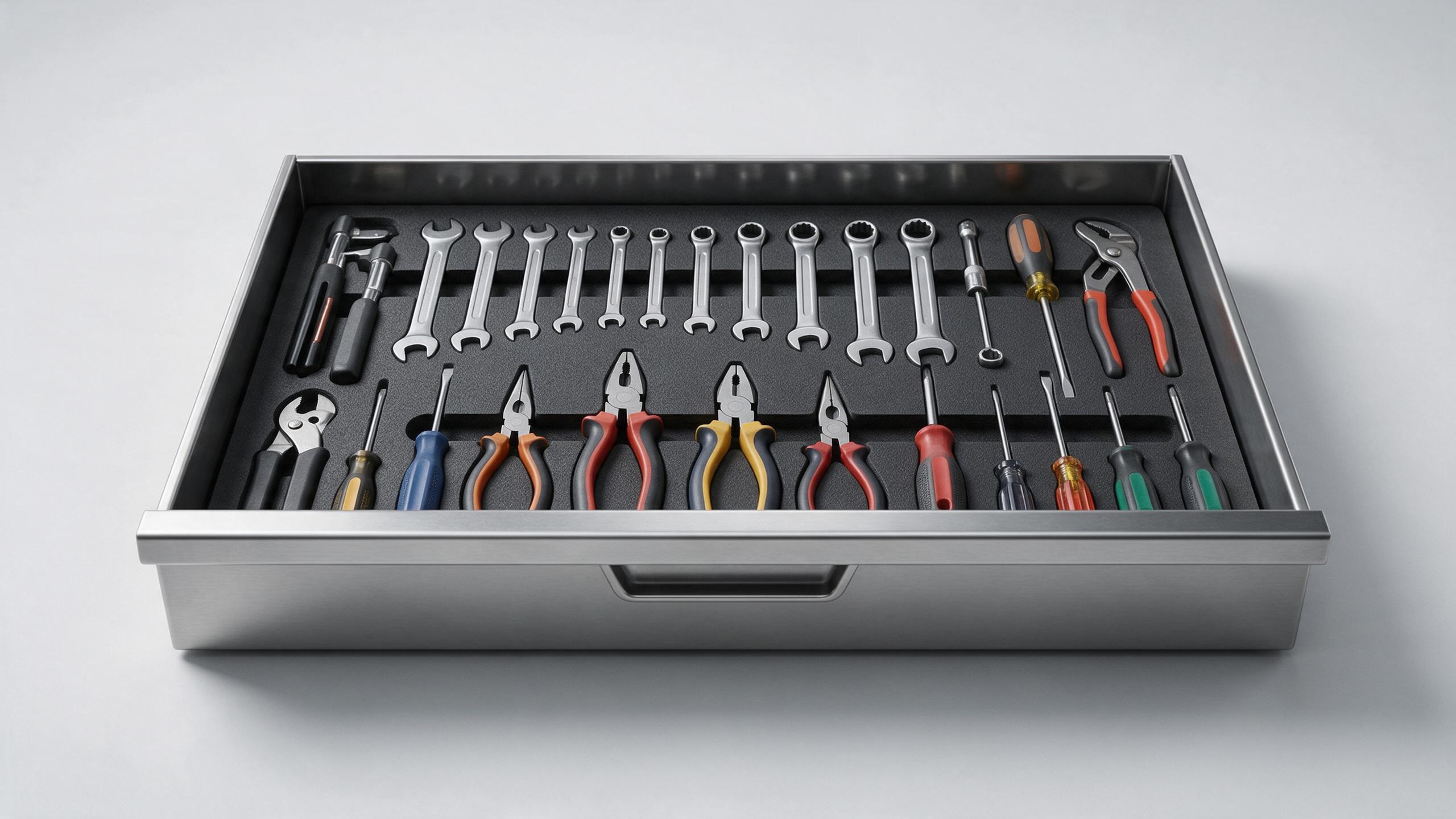
EVA foam tool control is often specified because it turns a general drawer into an accountable location for a defined tool group. A shaped insert can give each item a visible home, so a technician can scan a drawer instead of sorting through a loose pile. The goal is practical control, not decoration: the outline makes an absent tool easier to notice and helps the next user return tools to their intended positions.
For a professional tool box used by several people, that visibility can support a more consistent end-of-shift check. It also helps separate similar-looking tools or protect items that would otherwise contact one another during drawer movement. But foam is not an automatic solution for every drawer. The cutout pattern should reflect the actual inventory, tool sizes, cleaning needs, and likely changes in the kit. If the tool mix changes frequently, a modular or replaceable insert may deserve review; if the kit is stable, a dedicated layout can be easier to maintain.
A useful brief names the drawer, the tool family, the insert material, the desired labeling approach, and whether empty positions are acceptable. That turns a request for “foam organizers” into a reviewable requirement. It also prevents a common mistake: treating a full-looking drawer as an organized one.
Why full extension slides change the decision
Full extension slides matter when tools are stored toward the back of a drawer. With usable access to the entire drawer depth, a technician can see and reach the last row without unloading the first row. That can make a planned foam layout or divided drawer more practical, especially for long, flat, or carefully grouped tool sets.
Still, “full extension” is only one part of the specification. A professional tool box brief should ask the supplier to confirm the slide type, extension travel, rated load for the installed configuration, drawer dimensions, mounting method, and how the rating applies in the intended orientation and use. Slide performance should not be inferred from a generic cabinet description. The loaded drawer, the tools inside it, and the cabinet construction need to be considered together.
There is a simple practical test: can a user identify, remove, and replace the rear-most item without disrupting the front of the drawer? If the answer is no, the drawer may need a different organization scheme, different tool grouping, or a review of whether full extension slides are appropriate. That sounds straightforward, but the next question is how those tools actually move through the workspace.
What technicians include in a specification brief
A capable professional tool box begins with a clear scope rather than a short feature list. Master technicians commonly make the following points explicit:
- Tool inventory and frequency: Which tools are used every shift, which are shared, and which need a dedicated location?
- Drawer plan: What internal dimensions, depth bands, dividers, or EVA foam tool control layouts suit each group?
- Access requirement: Which drawers need full-depth visibility, and where might full extension slides support that need?
- Load and construction checks: What documented drawer-load information, cabinet construction details, and installation conditions must be confirmed?
- Workspace fit: Does the cabinet footprint, drawer opening clearance, and any mobility requirement work with aisles and adjacent equipment?
- Change control: If the tool set expands, can the drawer arrangement or inserts be updated without abandoning the overall layout?
This approach is more precise than requesting “heavy-duty” storage without defining the work it must support. It also helps procurement and workshop teams compare proposals on the same basis. The better fit depends on the workflow and verified configuration, not on a blanket ranking.
From drawer count to retrieval quality
A higher drawer count does not necessarily create a more useful layout. A cabinet with many shallow drawers may suit sockets, bits, measuring devices, and compact hand tools, while deeper drawers may be needed for larger kits or equipment. The issue is whether each drawer has a role. A professional tool box planned around retrieval quality gives every zone a reason to exist.
Consider the difference between storing tools by the empty space available and storing them by the action they support. The first approach can fill a cabinet quickly, but it can scatter a task kit across multiple drawers. The second approach may place related tools together, use EVA foam tool control where visual checks matter, and reserve full-depth access for drawers that need it. The result is a layout that can be inspected and adjusted, rather than merely filled.
Questions to ask before approving a professional tool box
Before finalizing a purchase or custom brief, ask for drawings, configuration details, and current documentation that match the proposed unit. Confirm what is included, what dimensions refer to usable internal space, and which parts of the specification are optional. For slide-equipped drawers, ask how the stated rating is defined and which conditions apply. For foam inserts, confirm the tool list and whether the layout is intended for a fixed or changing inventory.
It is not really a question of choosing the biggest cabinet; more accurately, it is a question of choosing the most usable layout for the work. A professional tool box earns its place when technicians can reach the tools they need, see what belongs in each drawer, and verify that the configuration supports the routine—not just the brochure.
Conclusion: specify the daily loop, then the storage
Master technicians specify a professional tool box because they understand that storage affects the daily loop of access, use, return, and review. They use EVA foam tool control to make assigned locations visible, consider full extension slides when rear-drawer access matters, and require the relevant dimensions and load information to be confirmed before approval.
Start with the tool flow, then turn that flow into a drawer plan and a verification checklist. That produces a clearer conversation with a supplier and a more defensible decision for the workshop.
 Hot News
